
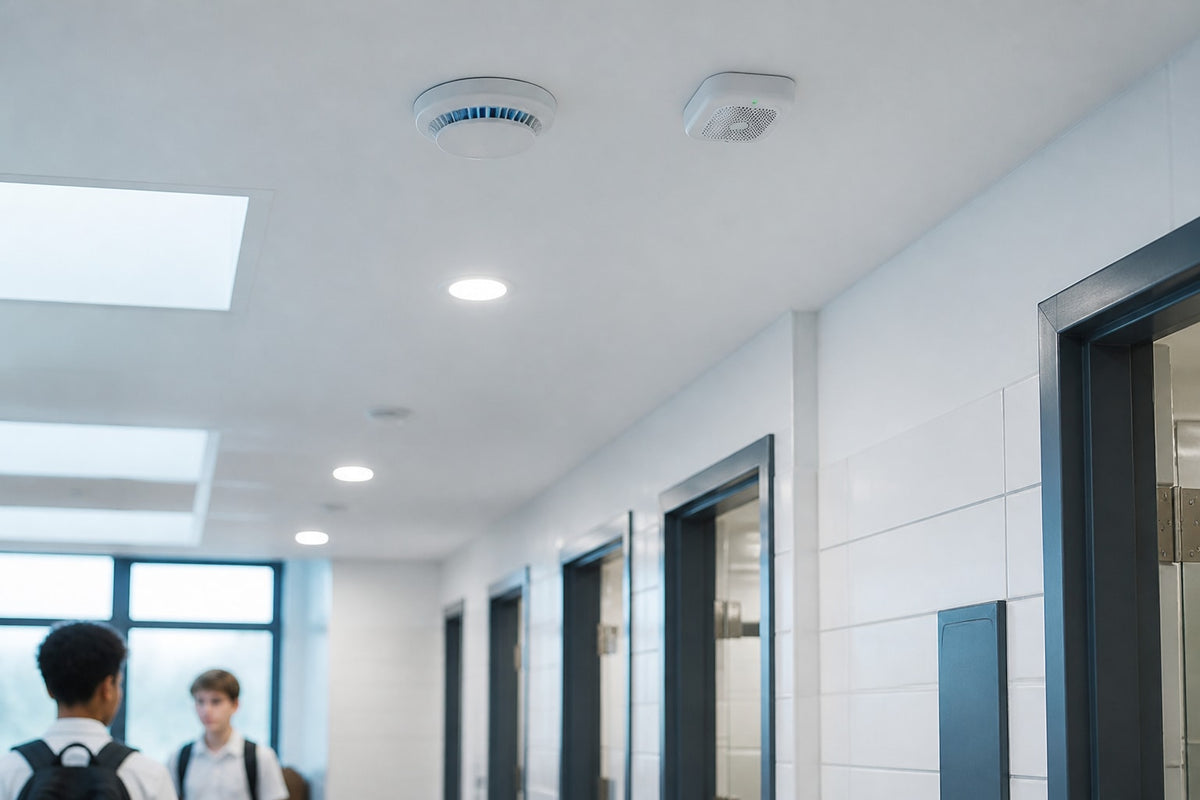
Can smoke detectors detect vape? Sometimes, but not reliably. A standard smoke alarm responds to airborne particles, and vape aerosol can trigger it in the right conditions, yet it is just as likely to ignore a pupil vaping in a toilet cubicle. For a headteacher or site manager, that inconsistency is the real problem: a fire alarm is designed to detect fire, not to tell you who is vaping and where.
This guide explains what sets smoke detectors off, why vaping so often goes unnoticed, and what schools and colleges can do about it.
How do smoke detectors work?
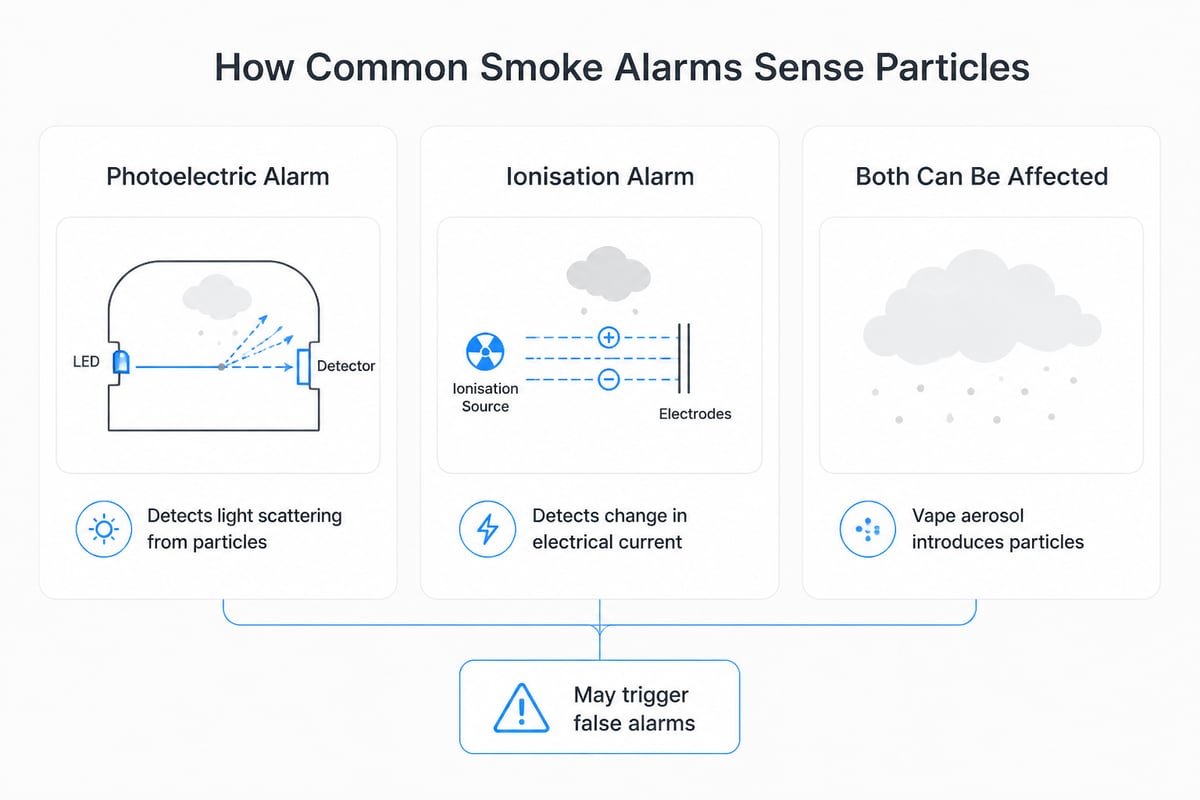
A smoke detector senses particles in the air inside a small sensing chamber and sounds an alarm when the reading crosses a threshold. It does not identify what the particles are made of.
Most domestic and commercial alarms fall into two types:
- Photoelectric alarms use a light beam inside the chamber. When particles drift in and scatter the light onto a sensor, the alarm sounds.
- Ionisation alarms use a small electrical current across the chamber. Particles disrupt that current, and the change triggers the alarm.
According to Rock Me Vape, vape aerosol can affect both types. That matters because it means a school cannot assume one kind of fire alarm is immune. It also means the alarm has no way of knowing whether the particles came from a fire, a cloud of aerosol or a can of deodorant.
Can a vape set off a smoke detector?
A vape can set off a smoke detector, but it is not guaranteed and depends on the detector, the room and how the device is used. The aerosol produced by an e-cigarette is made of fine droplets rather than combustion smoke, and many alarms are tuned to ignore small, short bursts of particles.
Rock Me Vape notes that smoke alarms respond to airborne particles without determining their source, so activation is possible but never certain. In practice, that gives schools an unreliable picture. One pupil may vape in a toilet for months without an alarm, while a single large cloud next to a ceiling detector could cause a full evacuation.
For safeguarding leads, an unpredictable trigger is worse than no trigger. It produces disruption without producing evidence.
What makes a smoke alarm more likely to go off?
An alarm is more likely to activate when a dense cloud of aerosol reaches the detector in a confined space with little airflow. A Vape Guardian fire-safety guide identifies these factors as raising the chance of activation:
- Dense aerosol. Large clouds from high-powered or disposable devices carry more particles.
- Close proximity. Vaping directly beneath or near a detector gives the sensor a stronger reading.
- Enclosed spaces. Small rooms and cubicles concentrate aerosol rather than dispersing it.
- Poor ventilation. Still air lets particles linger long enough to build up.
Pupils who vape in school toilets often do the opposite of what would set an alarm off. They exhale into sleeves, blow towards extractor fans or stand away from the ceiling detector. Many have also learned that a single quiet puff rarely triggers anything.
Why do pupils so often get away with vaping near smoke alarms?
Pupils get away with it because fire alarms are placed and calibrated for fire, not for the habits of someone vaping discreetly. Detectors are positioned to give early warning of burning material in corridors, stairwells and plant rooms. Many toilet blocks have no detector at all, or one set at a sensitivity that ignores brief, low-volume aerosol.
Several practical factors compound this:
- Disposable vapes produce small, quick exhalations that disperse before reaching a ceiling sensor.
- Extractor fans and open windows carry aerosol away from the detector.
- Alarms are deliberately set to avoid false activations from steam, dust and cleaning products.
- Detectors cannot distinguish nicotine vapour from THC or other substances.
This is why staff rely on smell, pupil reports and patrols, all of which are slow and inconsistent. If your toilets are the main concern, our guide to vaping detectors for bathrooms sets out why a purpose built approach works better than a fire alarm.
What happens if vaping does trigger the fire alarm?
If vaping triggers a fire alarm, the building responds as it would to any suspected fire: evacuation, a roll call and possibly a call to the fire and rescue service. That is a significant cost in lost teaching time and staff attention, and it can put the school in an awkward position over repeated false alarms.
False activations also carry a safety risk of their own. When alarms are frequently caused by pupils rather than fire, staff and pupils grow less responsive to them. Many schools therefore try to avoid a situation where a vape is the cause of a full evacuation, and the better answer is to detect vaping separately from fire.
It is also worth being clear about what not to do. Covering, disabling or tampering with a smoke detector to prevent vaping triggers is a serious fire safety breach and should never be considered. Detection for vaping should sit alongside fire protection, never in place of it.

What is the difference between a vape detector and a smoke detector?
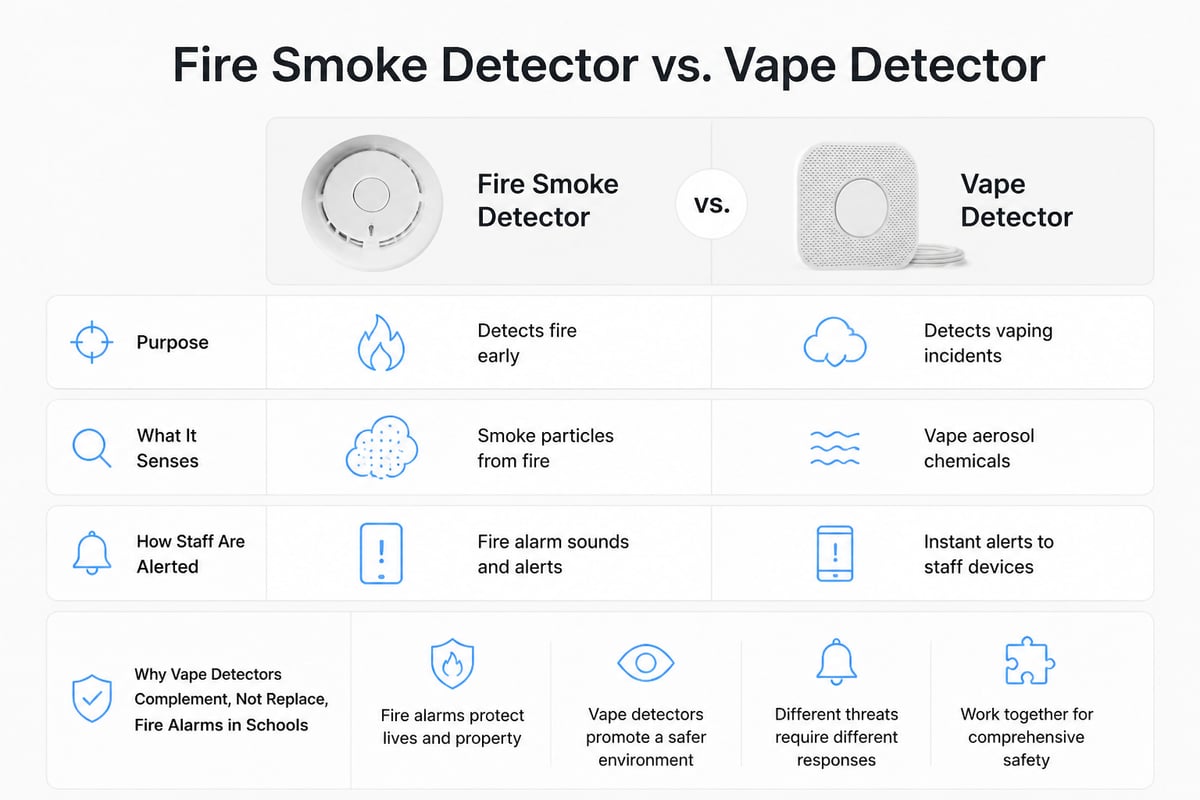
A vape detector monitors the air specifically for vaping-related aerosol and other targeted substances, while a smoke detector exists to give early warning of fire. As JEM Systems explains, a vape detector is distinct from a smoke or heat detector and is neither a fire detection device nor a replacement for fire alarms.
The two systems answer different questions:
| Question | Smoke detector | Vape detector |
|---|---|---|
| Main purpose | Warn of fire | Identify vaping and related behaviour |
| What it senses | Particles in a sensing chamber | Aerosol and air quality signatures |
| Can it tell nicotine vapour from steam? | No | Designed to |
| Alerts specific staff in real time | Sounds a building alarm | Sends targeted notifications |
| Replaces fire alarms | Is the fire alarm | No, it complements them |
For a deeper comparison, see our explainer on vape detector vs smoke detector and our overview of how vape detectors work.
Can smoke detectors detect vape in school toilets reliably?
No. Can smoke detectors detect vape in school toilets reliably is a question most site teams answer through experience: they pick up the occasional large cloud and miss the rest. A fire alarm cannot give you a time, a location or a pattern, and it cannot separate nicotine vaping from THC or other substances.
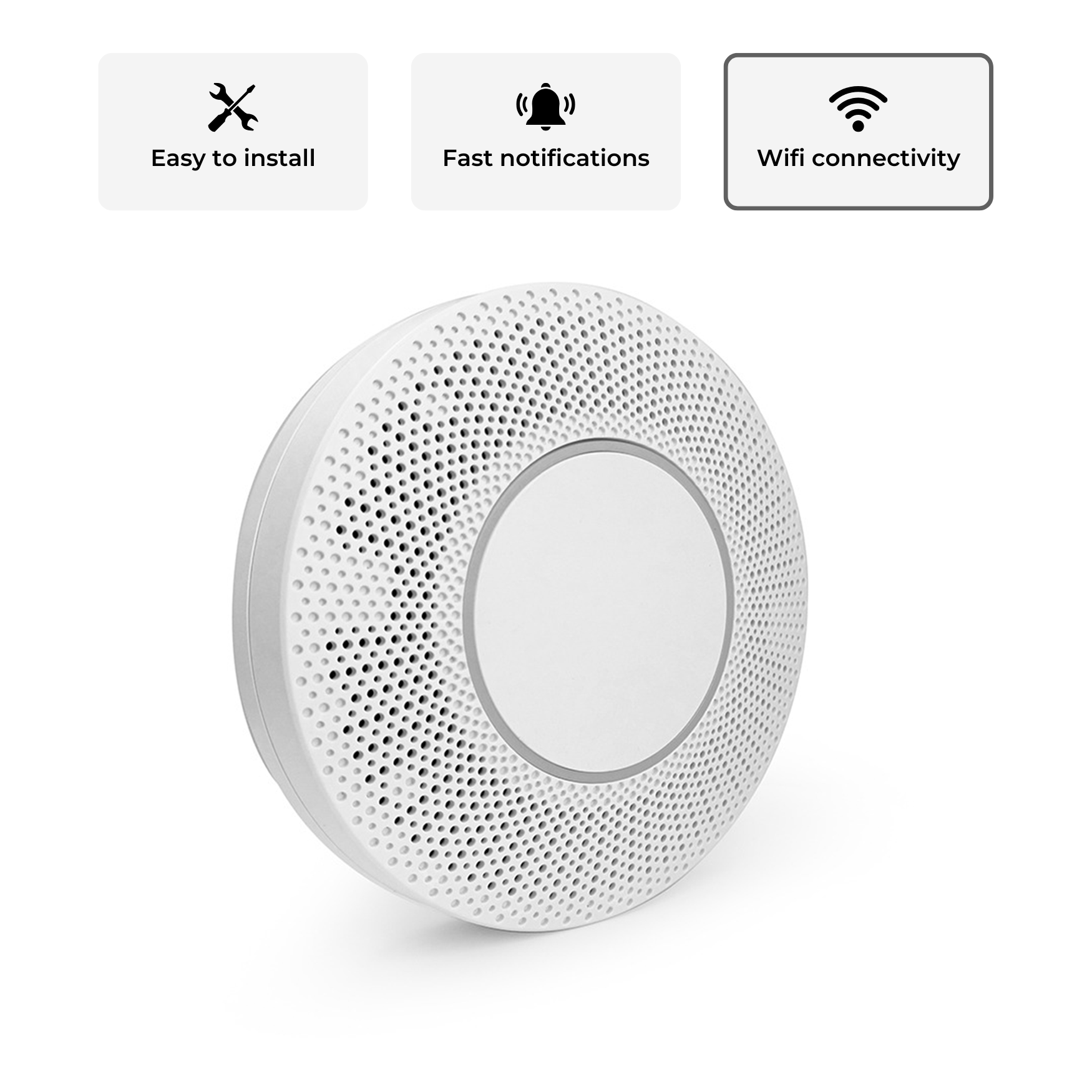
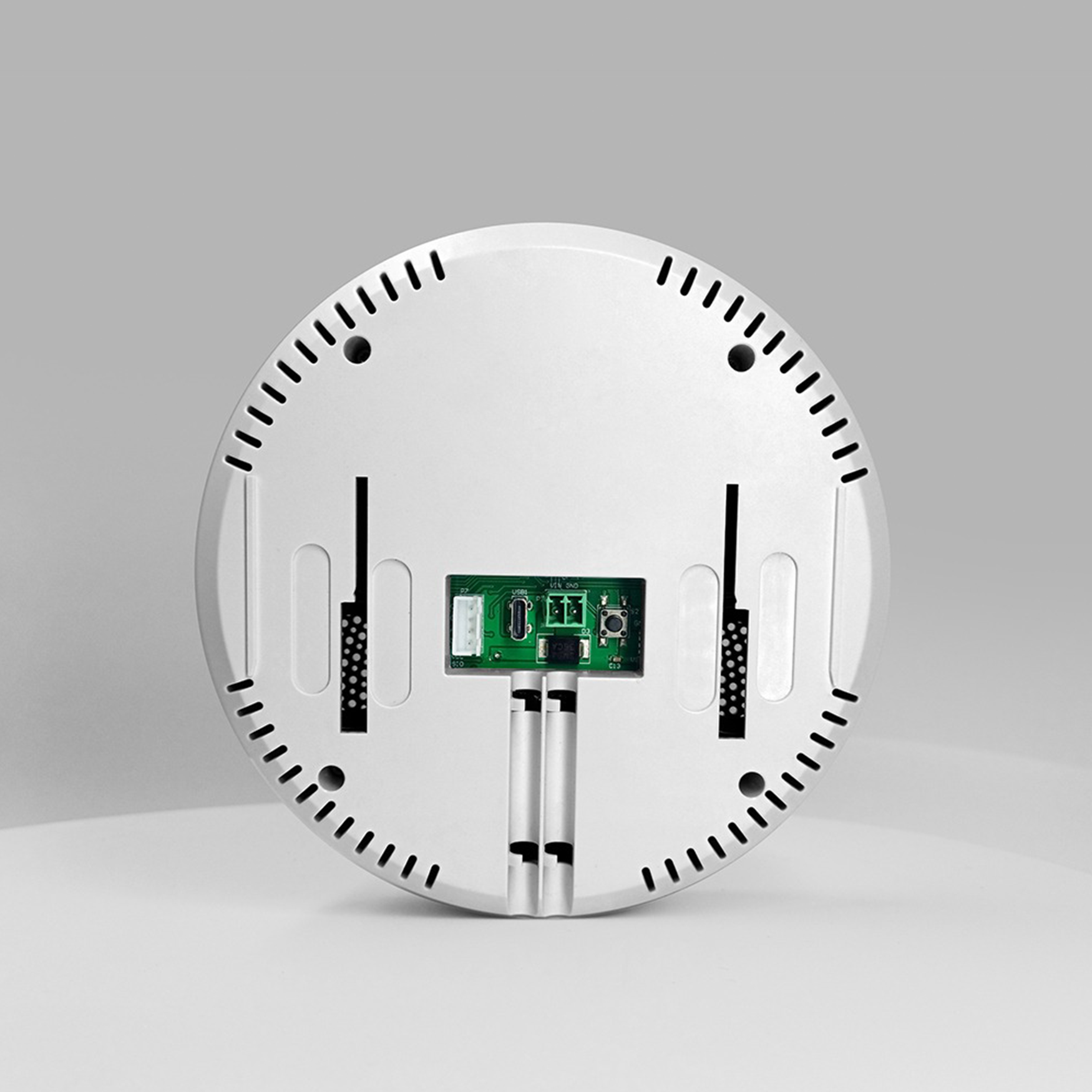
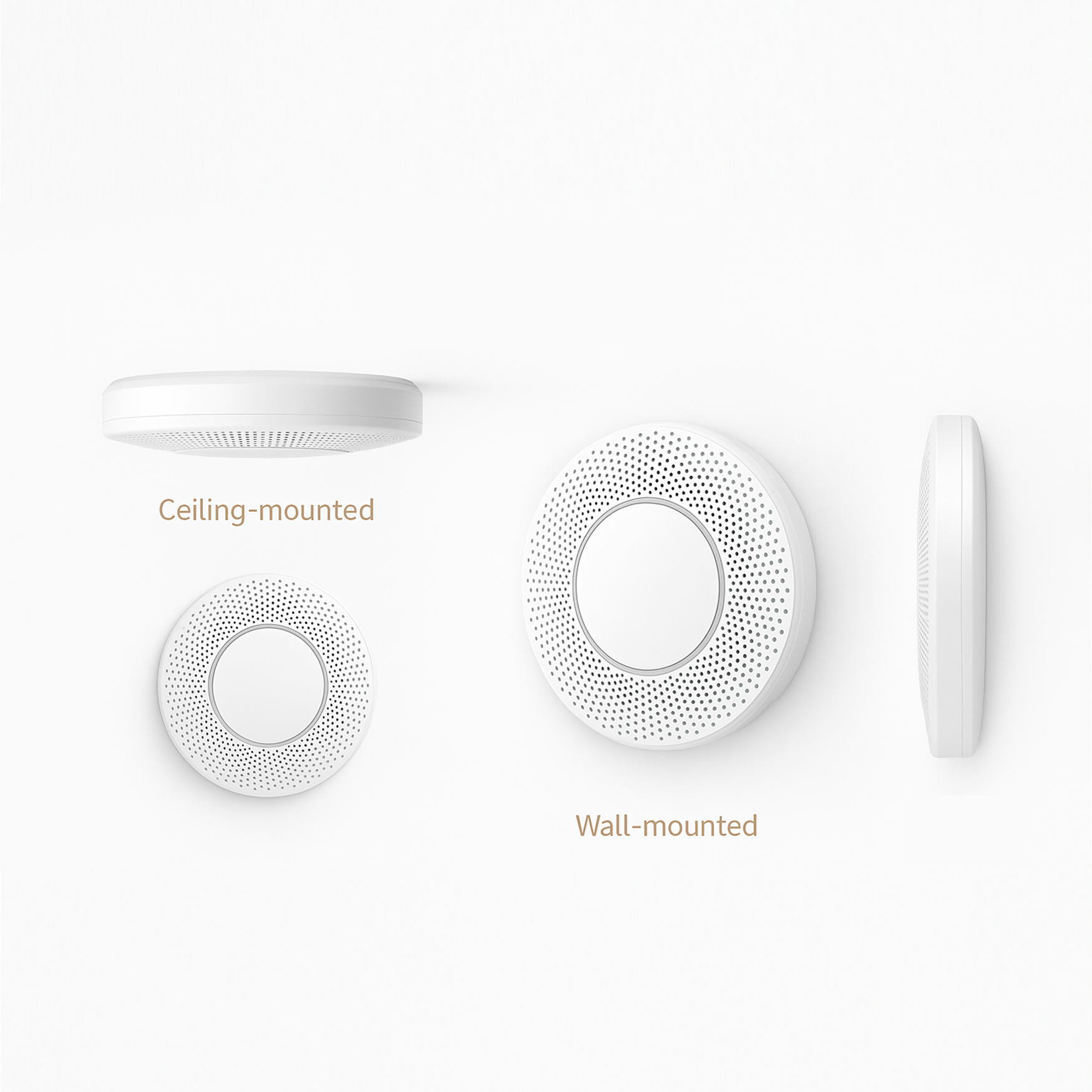
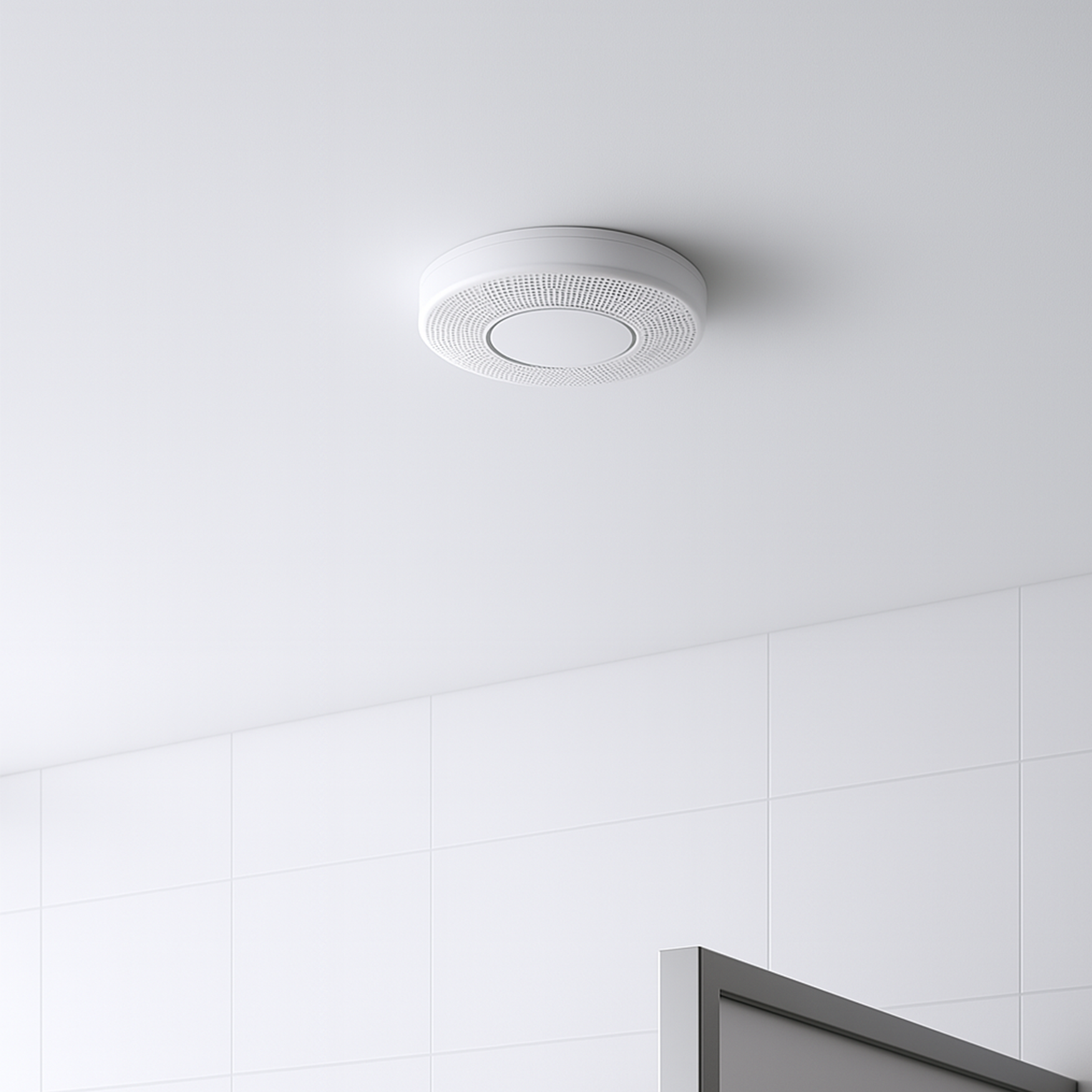
A purpose built sensor changes that. The Vape Detection System from Vape Guardian is designed to identify vaping accurately and send alerts to staff in real time, rather than relying on a building wide fire alarm to do the job by accident.
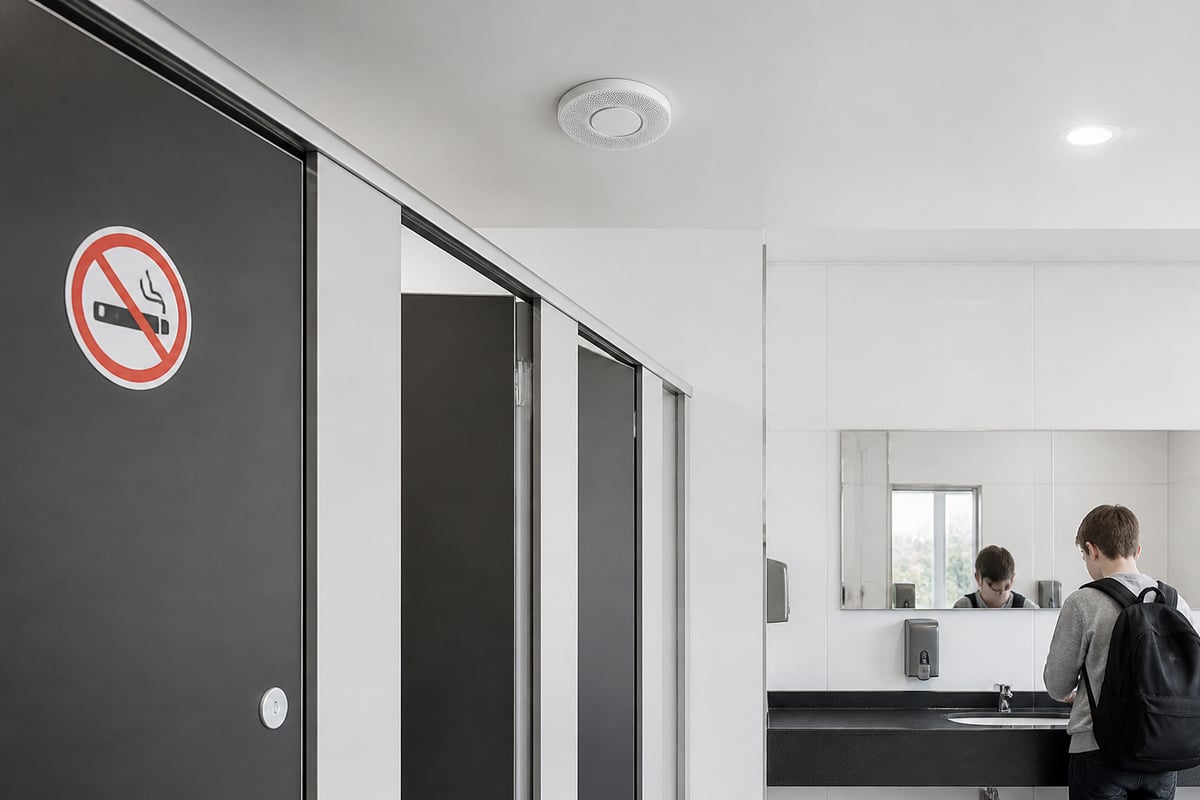
Vape Guardian's 10-point detection formula is designed to identify vaping accurately and avoid false positives. The sensors detect vaping, THC, Spice, over-occupancy, loud noise and cigarettes without cameras, which matters in spaces where privacy is paramount. Sensors are supplied with 'No Vaping' signage and unlimited notifications to unlimited staff, so alerts reach whoever needs them rather than a single office. Vape Guardian has installed sensors in hundreds of organisations across 27 countries, and schools using them report vaping incidents halved within two weeks.
Seaham High School has reported vaping in its toilets falling sharply since alarms were installed. For more detail on school deployments, see our guide to vaping detectors for schools.
Do air purifiers or extra ventilation solve the problem?
Air purifiers and ventilation can reduce lingering aerosol, but they do not stop vaping and they can make it harder to detect. Fans carry aerosol away from ceiling detectors, which is one reason smoke alarms miss it, and a purifier may clear the air before a member of staff arrives.
They are sensible for air quality in general. As a behaviour management tool, though, they treat the symptom without telling you who is vaping, where or how often. Without that information, safeguarding conversations rely on guesswork, and staff cannot identify the hotspots where intervention is most needed.
How should schools handle vaping beyond detection?
Detection works best when it leads to support, not only sanctions. Exclusion removes a pupil from lessons without addressing the dependency behind the behaviour, and it often leaves the underlying habit untouched.
Vape Guardian Education offers a student vaping course built around rehabilitation and education. It gives schools a constructive alternative to exclusion: once a sensor flags an incident, a pupil can be directed to a course that explains the health effects and supports them to stop, rather than being sent home to vape unsupervised. Pairing detection with education gives safeguarding leads something to offer, as well as something to enforce.
A sensible approach has three parts:
- Detect vaping in toilets, changing rooms and secluded areas with sensors designed for the job.
- Respond consistently, using alerts to target patrols and conversations.
- Educate through a structured course so that pupils can change the behaviour.
On the legal position, the Tobacco and Vapes Act gives government powers to make indoor places vape-free, but no start date has been set. Schools should not wait for legislation and should set their own site policy now.
What should a school do next?
Start by mapping where vaping happens on site and whether any of those areas have fire detection that could realistically pick it up. Record incidents for a few weeks and note times, locations and patterns, because that evidence shapes where sensors should go.
When assessing solutions, ask specific questions:
- Is the system designed for vaping, or is it a general air quality monitor?
- Does it avoid false positives, and how is that achieved?
- Who receives alerts, and is there a cap on notifications or users?
- Does it use cameras, and what are the privacy implications?
- What support and firmware updates are included?
Vape Guardian's sensors are designed and developed in the UK, with hardware and software built in-house. Over the air firmware updates come at no added cost, a UK support team of software, hardware and vaping specialists is available, and a 100-day money-back guarantee applies if you are not satisfied.
FAQ
Is 1 puff of a vape equal to one cigarette?
No reliable equivalence exists. Vapes and cigarettes deliver nicotine differently, and the amount varies with the device, the liquid strength and how someone inhales. A single puff cannot be converted into a number of cigarettes.
Will one puff of a vape trigger a smoke detector?
Usually not. One brief, small exhalation tends to disperse before it builds enough particles to reach an alarm threshold. Alarms are more likely to activate when dense aerosol is released in a small, poorly ventilated space close to the detector.
Should schools rely on fire alarms to catch vaping?
No. Fire alarms exist to protect life from fire and are not designed to identify or locate vaping. Relying on them leaves most incidents undetected and risks disruptive false evacuations when they do activate.
Your next step is to walk your toilet blocks and changing rooms, note where there is no useful detection, and gather a few weeks of incident data. If you would like to see how purpose built sensing compares with what you have now, the Vape Detection System is a good place to start reading. Vape Guardian provides vaping detection and air quality monitoring for schools, with reliable sensors and dedicated UK support, so you can get a quote or book a 15-minute call to talk through the right setup for your site.



Share:
Vape Detectors for FE Colleges: A Practical Guide
Vape Sensors for Schools: Compare Top Detectors