
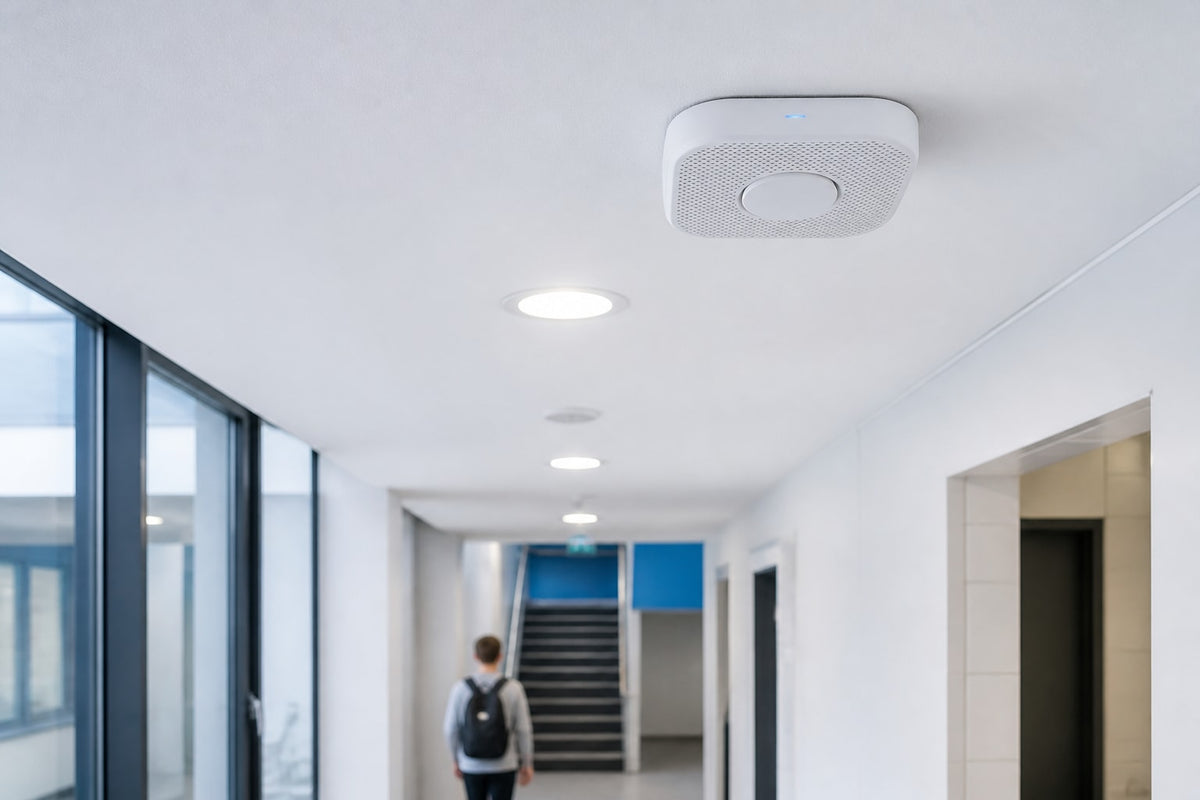
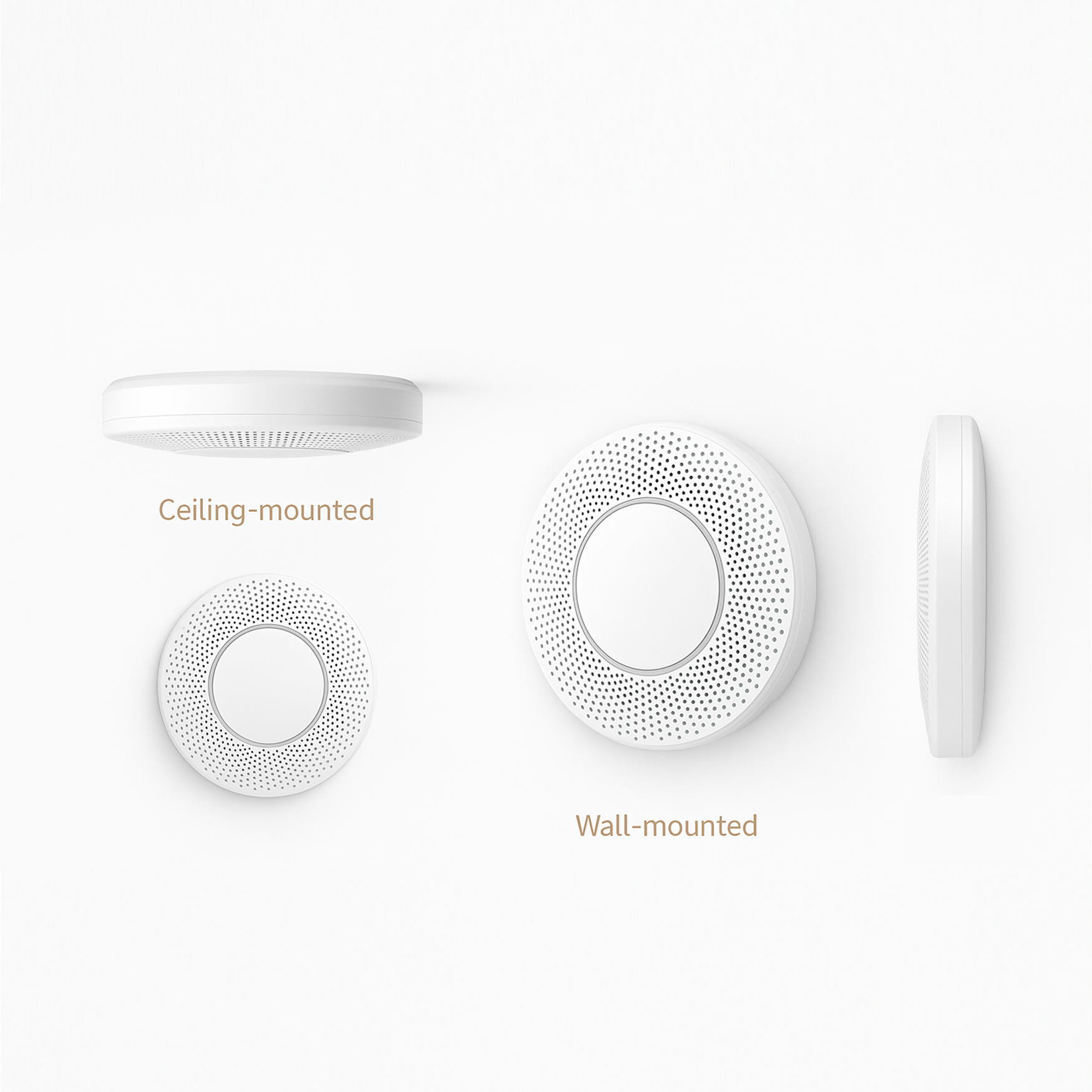
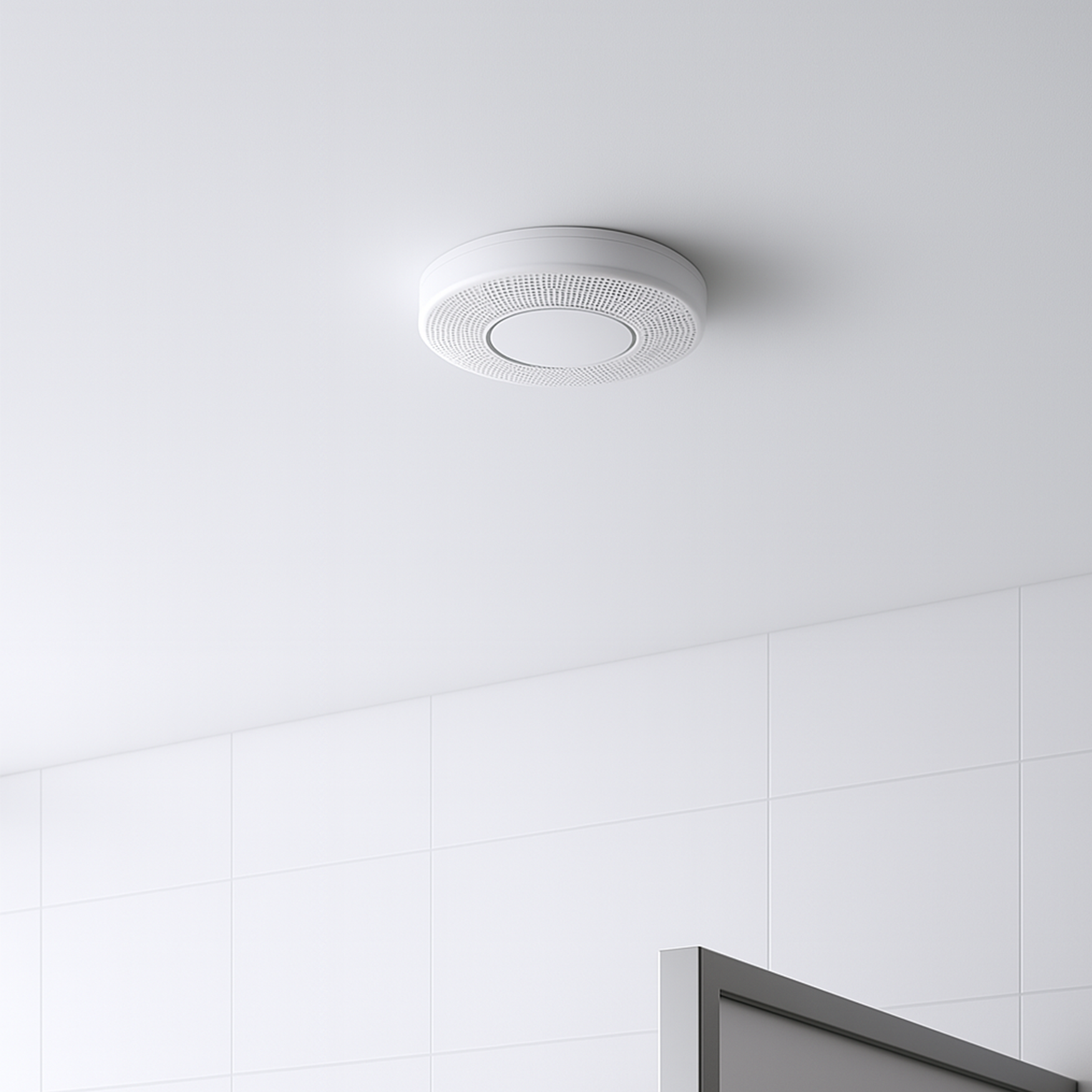
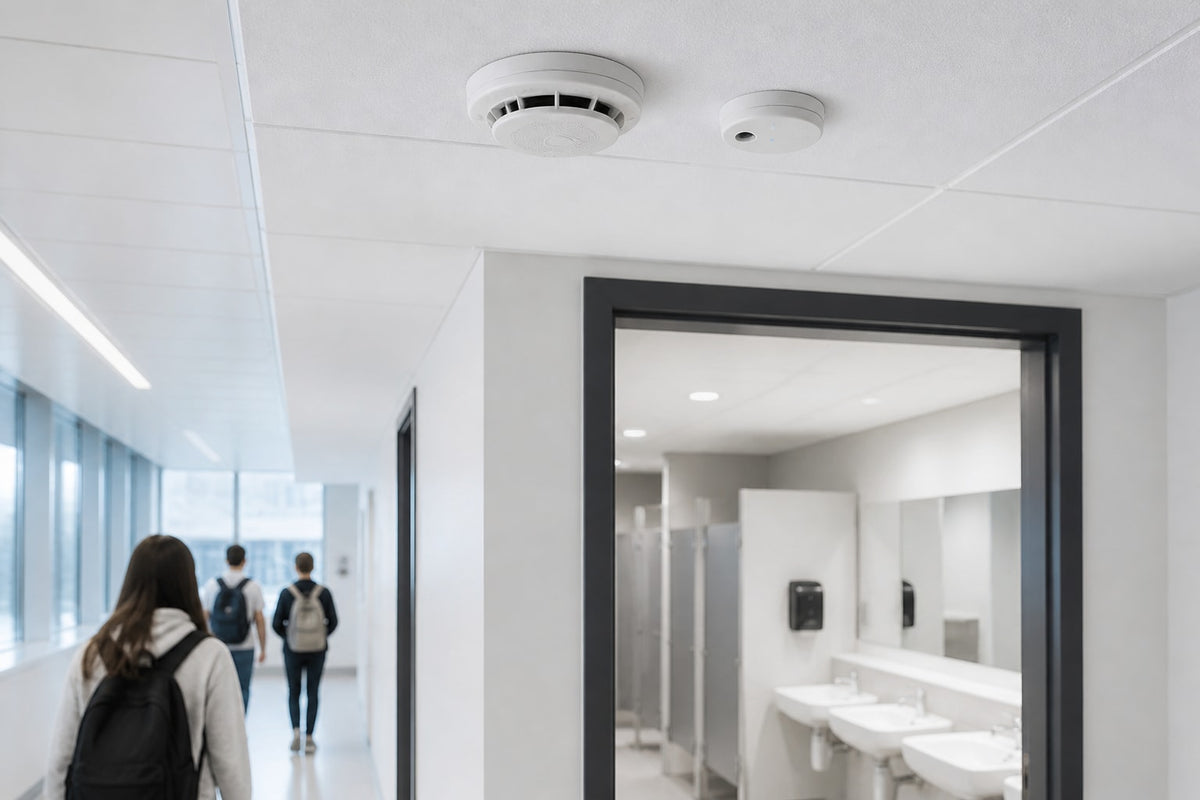
Vape detectors for hotels are ceiling-mounted sensors that identify vape aerosol in the air and send an instant alert to staff, so a room or corridor can be checked before the smell or residue spreads. Hotels are the focus of the search, but the same technology answers a problem that headteachers, safeguarding leads and site managers know well: how to stop vaping in toilets and secluded areas without placing cameras in sensitive spaces. This guide explains what to compare when choosing a sensor, and how the lessons from hospitality translate directly to a school or college site.
Why hotels are installing vape detectors
Hotels install vape detectors because vaping in guest rooms and corridors leaves odours and residue, creates complaints and, in some jurisdictions, breaches local law. Staff cannot patrol every room, so a sensor does the watching and reports only when it is needed.
The regulatory picture in hospitality is a useful reference point. Orleans Parish, for example, requires hotels and motels to prohibit smoking and vaping in all indoor areas, and the New Orleans Health Department recommends prominent signage, staff training and reminders at booking and arrival. That combination of clear rules, communication and monitoring is exactly what a well run school policy relies on.
There is also a health argument that applies to any shared building. The National Institutes of Health notes that nicotine vaping aerosols can contain nicotine, heavy metals, volatile organic compounds and cancer causing agents, exposing bystanders as well as users. In a school, the bystanders are other pupils, and the cubicle next to the one being used is not a safe distance.
If you want a hospitality specific view, Vape Guardian has a short piece on vaping in hotels that sets out the operational problem from the hotelier's side.
What a vape detector actually senses
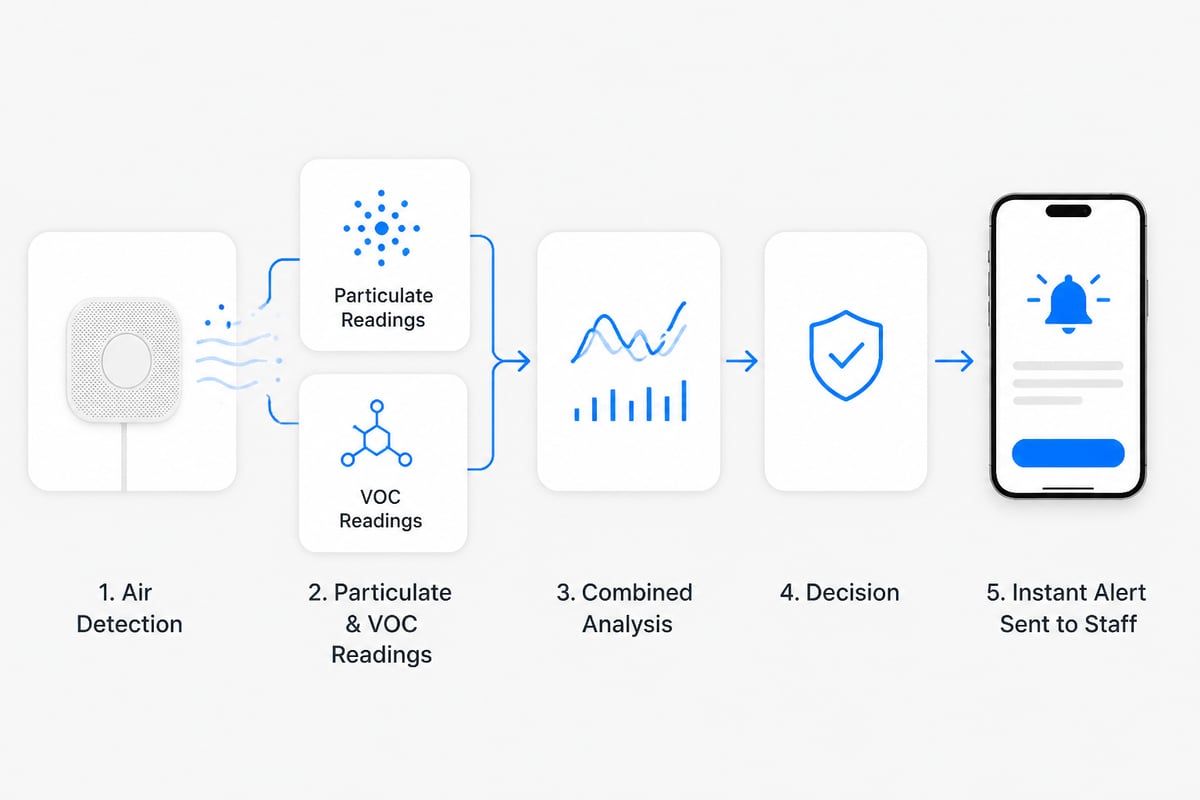
A vape detector measures changes in air chemistry and particle levels that are characteristic of vaping, then compares those readings against a detection model to decide whether an alert is warranted. It does not rely on smoke density in the way a fire alarm does, which is why a standard smoke detector will usually stay silent when someone vapes.
Most modern sensors combine several readings rather than trusting a single one. Typical inputs include:
- Fine particulate matter, which rises sharply when aerosol is exhaled
- Volatile organic compounds, which change with vape liquid vapour
- Humidity and temperature shifts that accompany a plume
- Background noise or occupancy, depending on the unit
The more signals a device weighs together, the better it separates a vape from an aerosol deodorant, a hand dryer or a steamy shower. For a deeper explanation, the Vape Guardian guide on how vape detectors work walks through the principles in plain language.
Why smoke alarms and ventilation are not enough
A smoke alarm is designed to detect combustion, not vape aerosol, so it will rarely respond to the amount of vapour produced in a toilet cubicle. Relying on one leaves a gap that pupils and guests quickly learn about.
Ventilation does not close the gap either. The National Institutes of Health states that opening windows, using fans or ventilation, and restricting smoking to certain rooms do not eliminate exposure to secondhand smoke and aerosols. In practical terms, extractor fans in a school toilet may clear the smell, but they do not remove the aerosol exposure for the next person in the room, and they remove the evidence staff would otherwise notice.
This is why a dedicated sensor is a different category of equipment from a fire detector. If you are weighing the two, the article on vape detectors in bathrooms sets out the evidence and best practice for placement in washrooms specifically.
What to compare when choosing vape detectors for hotels and schools
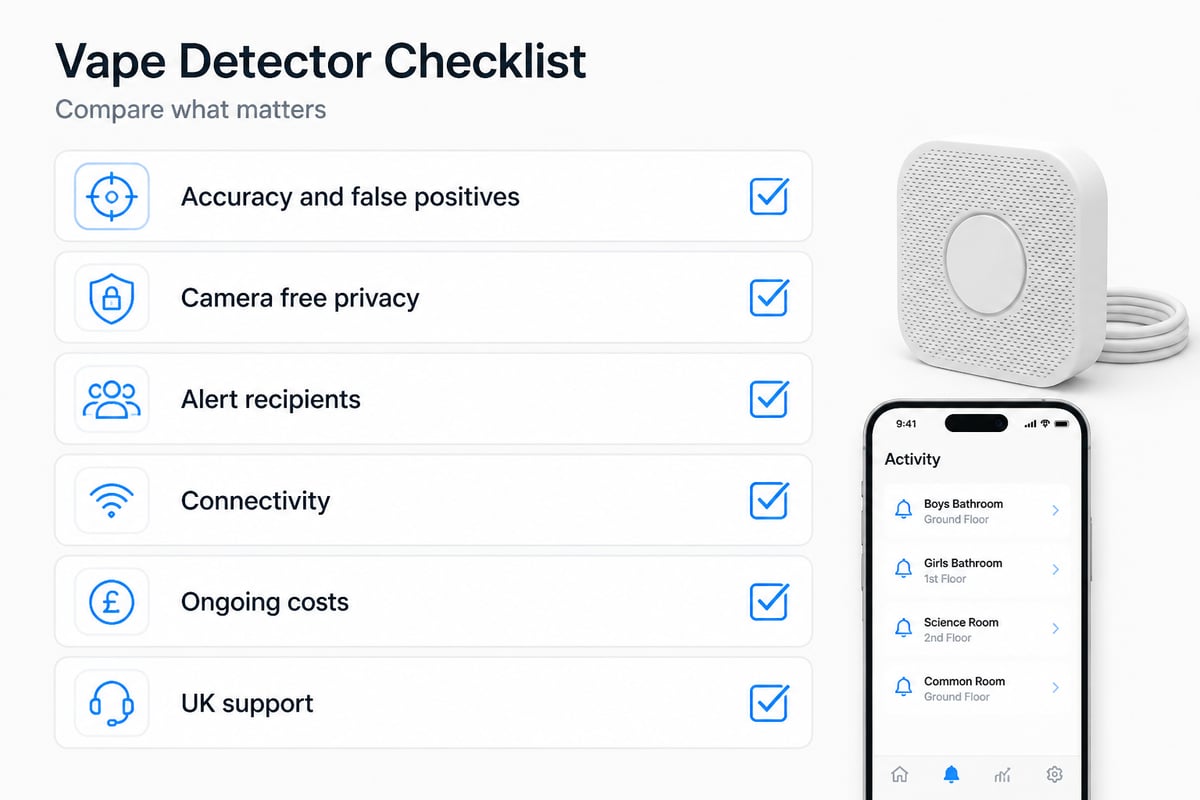
The most useful way to compare vape detectors for hotels, and for schools, is to test each product against the same short list of practical questions. A device that looks impressive on a data sheet can still fail on a busy site if it floods staff with false alarms or cannot be installed where the problem actually occurs.
Accuracy and false positives
False alerts erode trust faster than anything else. If staff are sent to an empty toilet three times in a morning, they will stop responding on the fourth. Ask any supplier how their detection logic distinguishes vaping from aerosols and steam, and ask for accuracy figures rather than adjectives.
Privacy
Sensors should work without cameras or microphones that record speech. In a school toilet or changing area, anything that records images or audio is unacceptable on safeguarding grounds, and parents will rightly object. Detection based on air quality and noise level, not recording, avoids the issue entirely.
Alerts and who receives them
Check how alerts are delivered, how many staff can receive them and whether there is a charge per user. A sensor that only a single caretaker can hear about is of limited use during a lesson change.
Connectivity and installation
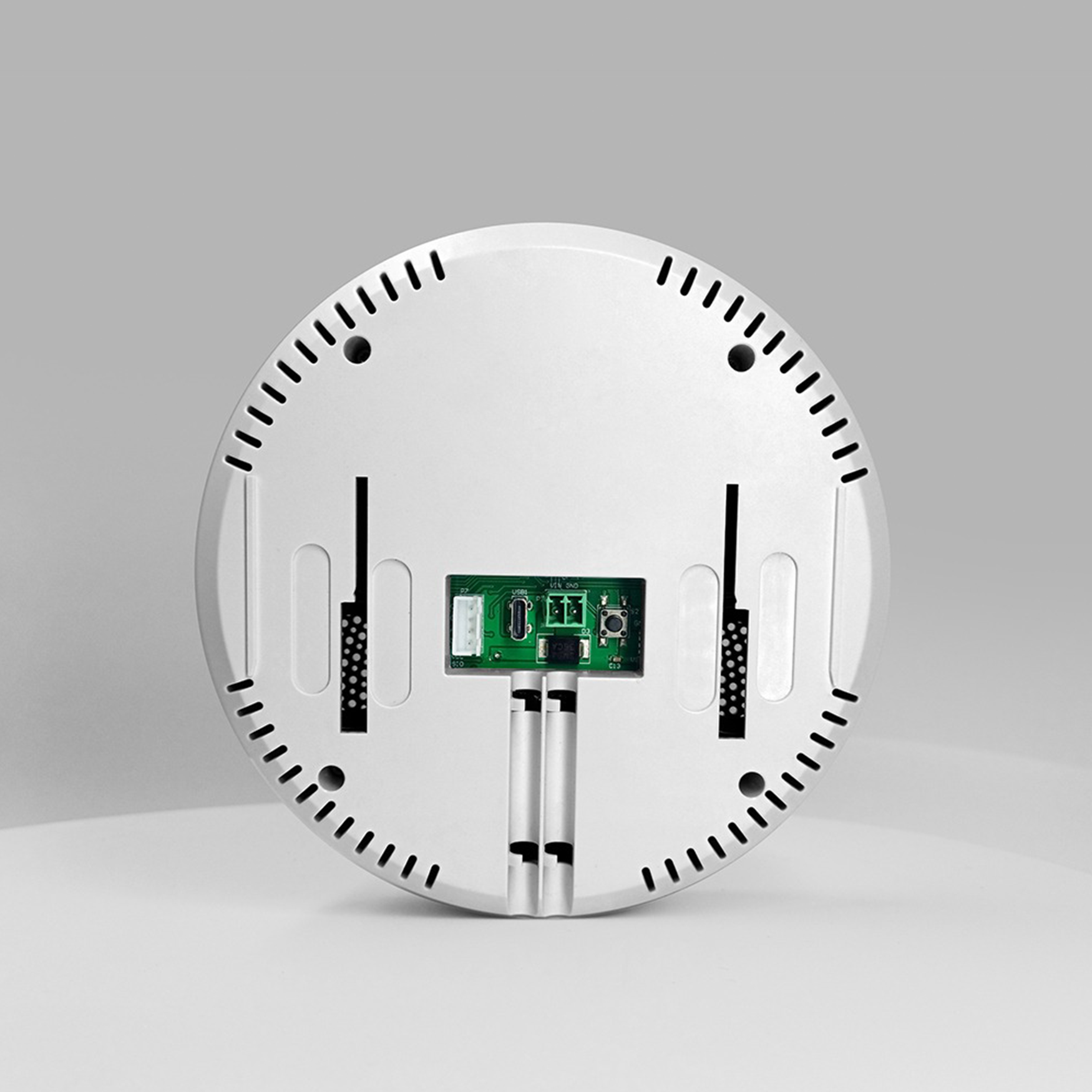
Consider whether the sensors rely on Wi-Fi or a mobile connection, and whether your toilet blocks have reliable coverage. Mounting should be simple enough for your site team to manage, with minimal disruption to the building.
Ongoing costs and support
Look beyond the unit price at software subscriptions, connectivity fees and what happens when the firmware needs updating. UK based support, with people who understand the product and the setting, is worth asking about before you buy rather than after.
How the hospitality approach translates to schools and colleges
The hospitality model of clear rules, visible signage, quick response and consistent follow up transfers to a school almost unchanged. A hospitality focused article from Business Age discusses setting and communicating a consistent policy, how staff should respond and the operational considerations that follow. Replace guests with pupils and the logic holds.
For schools, the high risk locations are predictable: toilets, changing rooms, stairwells, behind sports halls and any corridor away from a staffed area. Pupils choose these spaces precisely because adults are not present, which is where a sensor does its best work.
A practical approach looks like this:
- Map the incidents you already know about, using behaviour logs and staff reports.
- Prioritise the toilets and secluded areas with the most reports.
- Put up clear signage so the policy is visible before a detector ever sounds.
- Agree who responds to an alert, how quickly and what happens next.
- Review alert data weekly to spot patterns by time of day and location.
For policy wording, the free vape free policy template gives safeguarding leads a starting point they can adapt rather than draft from scratch.
The Vape Guardian approach
Vape Guardian is a UK based provider, with hardware and software designed and developed in house. Its detection uses a 10 point formula intended to identify vaping accurately and avoid false positives, and the company reports 96% alert accuracy.
Some of the points that matter to a school or college site manager:
- Detection of vaping, THC, Spice, over-occupancy, loud noise and cigarettes without cameras
- Sensors supplied with "No Vaping" signage
- Unlimited notifications to unlimited staff
- Over the air firmware updates at no added cost
- A UK support team of software, hardware and vaping specialists
- A 100 day money back guarantee if you are not satisfied
Scale and results are worth weighing too. Vape Guardian reports 2,400 sensors installed, 14,540 weekly alerts and use by organisations in 27 countries. Schools report vaping incidents halving within two weeks and almost eliminated by week five. At Seaham High School, vaping in toilets has fallen since the alarms were installed.
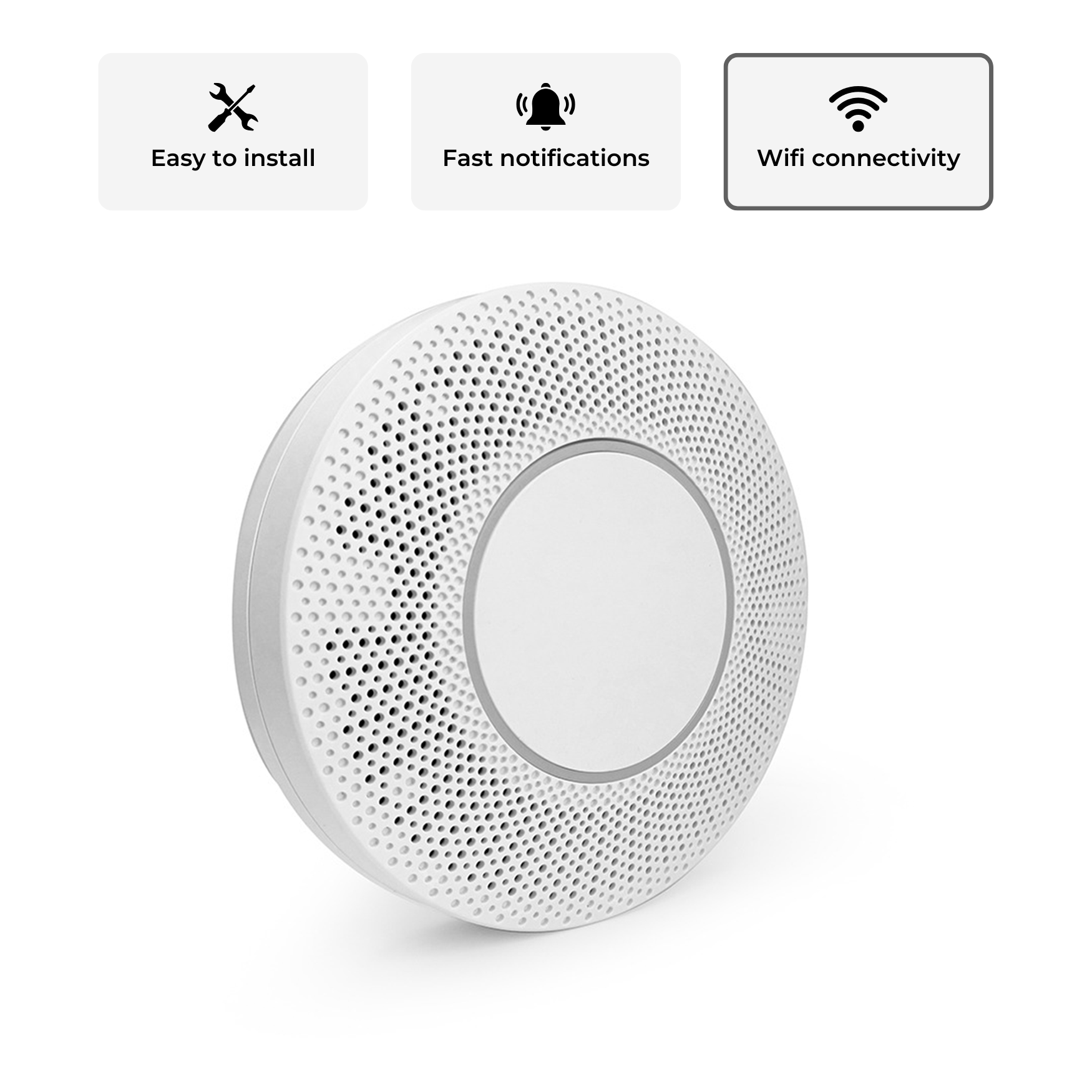
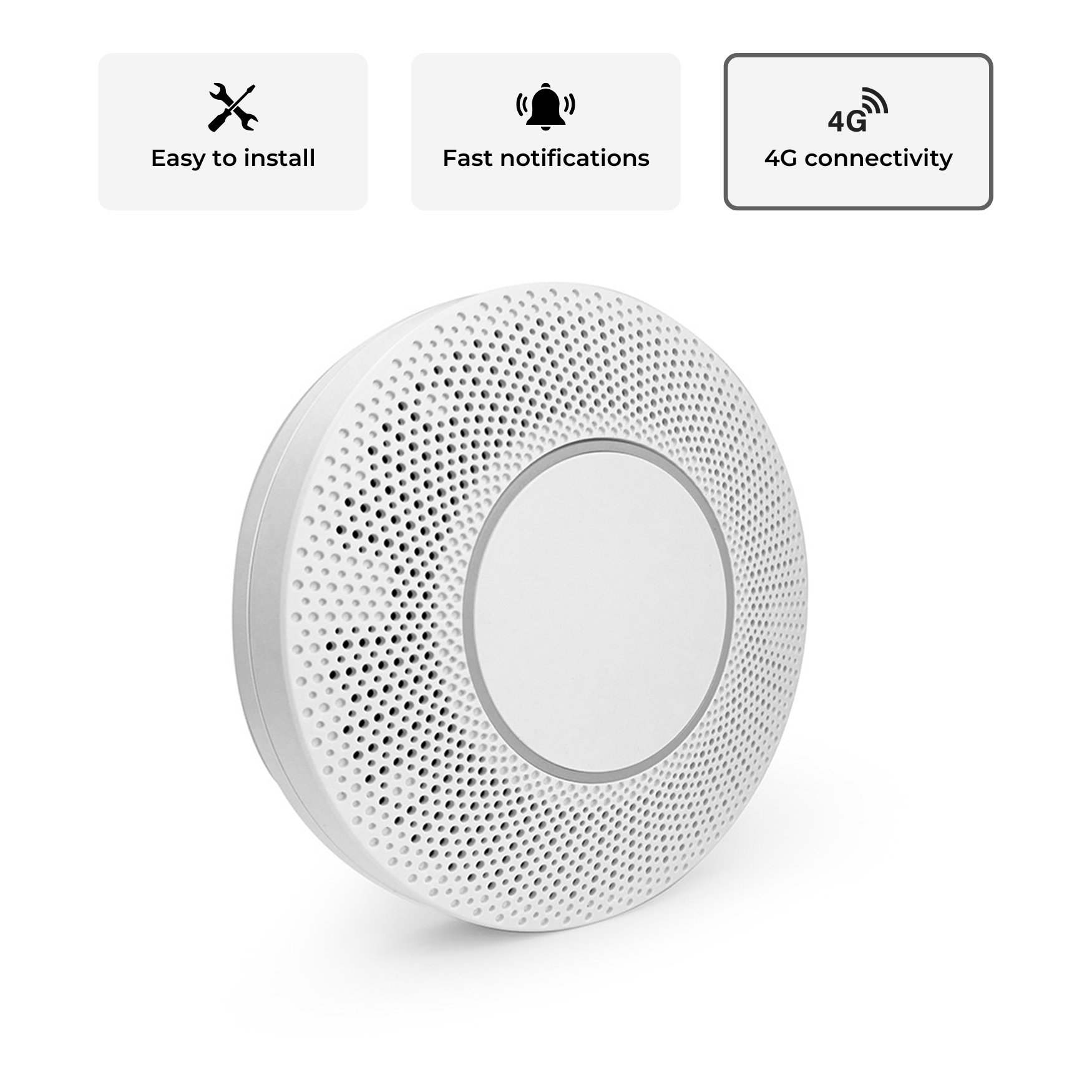
For schools comparing sensor types, the Vape Guardian Wi-Fi and 4G sensors are priced at £249 each, with software at £19.99 per month and, for 4G units, £3 per month per sensor for connectivity. A school with solid Wi-Fi in its toilet blocks can use the Wi-Fi version, while a 4G sensor suits locations where coverage is weak.

Detection works best alongside education
A sensor tells you that vaping is happening and where, but it does not change why a young person is vaping. Schools that rely on detection alone often find that pupils simply move to the next unmonitored space, or that exclusion becomes the default consequence, which removes a pupil from the very structure that might help them.
Vape Guardian Education, available at vapeguardian.education, is a student vaping course built around rehabilitation and education. It gives schools a constructive step to take when an alert leads to a conversation, as an alternative to exclusion. Many nicotine dependent pupils need support to stop rather than a sanction alone, and pairing detection with a course creates a consistent pathway: an alert, a conversation, a structured programme and follow up.
This also fits the wider safeguarding picture. Vaping can be a route into smoking for some teenagers, as covered in the piece on vaping as a gateway to smoking for teens, which makes early, supportive intervention more valuable than a short term punishment. For schools reviewing their options, the article on alternatives to exclusion for vaping sets out other approaches that sit alongside a course.
Legal context for UK schools
The legal position on vaping in public indoor spaces is still developing, and it is worth being careful with what you tell staff and parents. The Tobacco and Vapes Act gives government powers to make indoor places vape free, but no start date has been set, so a school should not describe any indoor ban as confirmed or give a date for one.
That does not weaken the case for acting now. Schools already have the authority to set their own rules on site, and a clear policy, supported by detection and education, does not depend on new legislation.
Battery safety is a related operational point. Confiscated vapes contain lithium-ion batteries, and the U.S. Fire Administration provides practical lithium-ion fire prevention guidance that can inform how your staff store seized devices.
Practical questions to ask before you buy
Before signing anything, put these questions to every supplier you consider, including those offering vape detectors for hotels that you are assessing for a school site:
- What accuracy rate do you report, and how is it measured?
- Does the system use cameras or record audio?
- How many staff can receive alerts, and is there a per user fee?
- What are the full running costs, including software and connectivity?
- How are firmware updates delivered, and do they cost extra?
- Who answers the phone when something goes wrong, and where are they based?
- Is there a money back guarantee if the sensors do not suit our building?
Write the answers down and compare them side by side. A supplier who is transparent on these points is usually one who will be reliable after installation.
Start by listing the five toilets or secluded areas in your building with the most reported vaping, because that shortlist tells you how many sensors you need and where. Vape Guardian can then match sensors to those locations, and you can pair them with the Wi-Fi and 4G sensors that suit your site's connectivity. To see how detection and education fit together in your school, get a quote or book a 15 minute call with Vape Guardian.


Share:
Vaping Rehabilitation for Secondary School Pupils: A Guide
Vape Detection for Student Accommodation: A Guide