

Supporting teenagers to stop vaping works best when adults stay calm, listen first, and pair practical quit tools with consistent boundaries rather than punishment. Young people who vape can become dependent on nicotine, so they need patience, a clear plan and support from home and school working in the same direction.
The NHS advises that most vapes contain nicotine, which is addictive and can be difficult to stop using, and that children and young people should not vape. This guide is written for headteachers, safeguarding leads and site managers who advise parents, and for the parents themselves. It sets out what to say, what to expect and how education settings can reinforce a teenager's decision to quit.
Why teenagers find it hard to stop vaping
Teenagers find it hard to stop vaping because nicotine dependence develops quickly, and vaping is often tied to social habits, stress and boredom. A young person may feel they have chosen to vape, yet find that cravings make stopping far harder than they expected.
Disposable devices deliver nicotine in very small, frequent doses. That pattern encourages near constant use throughout the day, including in school toilets and other secluded spots where pupils feel unobserved. Truth Initiative research found that young people enrolled in a quit-vaping programme reported using e-cigarettes on 26 days of the previous month, compared with 13 days among a general sample of young people who wanted to quit. Heavier users, in other words, are the ones most likely to seek help, and they need more than willpower.
The desire to quit is often already there. The same organisation reported that most 15 to 24 year olds surveyed in December 2023 said they were considering quitting vaping as a New Year's resolution. Adults rarely need to persuade a teenager that vaping is a problem. They usually need to make it safe to admit it.
How to start the conversation without causing conflict
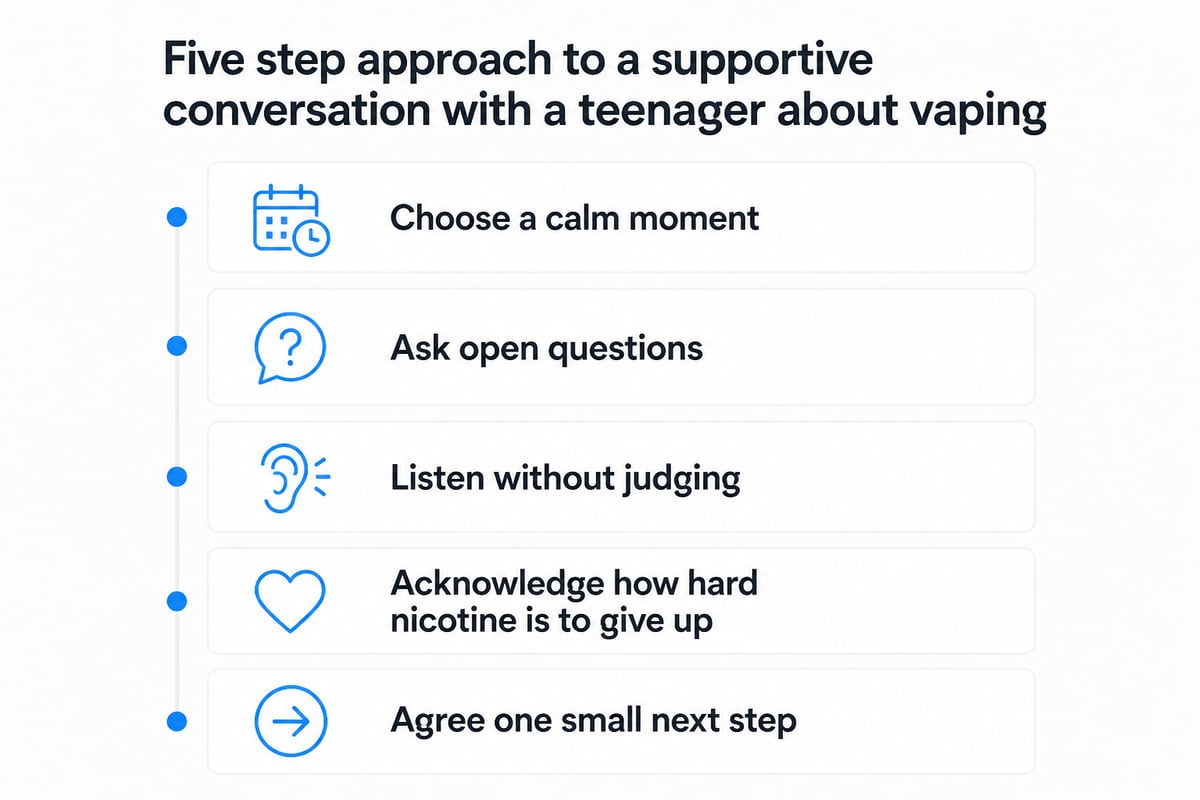
Start the conversation at a calm moment, ask open questions and listen before offering any advice. A teenager who feels interrogated will stop talking, while one who feels heard is far more likely to accept help.
These approaches tend to work well:
- Choose the setting carefully. Side by side activities such as a car journey or a walk feel less confrontational than a formal sit down talk.
- Open with curiosity. Ask what vaping does for them, when they use it and how they feel when they cannot.
- Avoid labels. Phrases such as "addict" or "you're ruining your health" prompt defensiveness.
- Acknowledge the difficulty. Saying that nicotine is hard to give up shows you understand what they are facing.
- Agree a next step together. End the conversation with one small, specific action rather than a long list of demands.
Expect the first conversation to be imperfect. A teenager may deny vaping, shrug or leave the room. That does not mean the conversation failed. It means a second, calmer one is needed.
What are the symptoms of quitting vaping?
The symptoms of quitting vaping are nicotine withdrawal effects, most commonly irritability, anxiety, difficulty concentrating, trouble sleeping, restlessness and strong cravings. They are uncomfortable but temporary, and they usually ease over a few weeks.
Teenagers may not recognise these feelings as withdrawal. A pupil who becomes short tempered at home, struggles to focus in lessons or sleeps badly in the first week after stopping is often experiencing the effects of nicotine leaving the body. Understanding this helps parents and staff respond with patience rather than treating a difficult week as misbehaviour.
Practical ways to ease the process include:
- Keeping the teenager busy during times they would normally vape, such as after school or during breaks.
- Encouraging regular exercise, water and sleep.
- Identifying triggers, whether certain friends, places or moods, and planning around them.
- Speaking to a GP, school nurse or pharmacist about suitable support, since advice for under 18s differs from adult guidance.
Cravings tend to come in short waves. Helping a teenager ride out a craving for a few minutes, rather than aiming never to feel one, makes the goal feel manageable.
Is quitting vaping worth it?
Quitting vaping is worth it because it removes nicotine dependence, reduces health risks and gives a young person back control over their mood, money and attention. The NHS states that vaping is not risk free and that young people should not vape.
The NHS does acknowledge that vaping can help some adult smokers move away from cigarettes, and its guidance on vaping to quit smoking is clear that this is not a reason for young people or non smokers to start. For a teenager who has never smoked, vaping offers no benefit and carries the cost of dependence.
There are everyday gains as well as health ones. Teenagers who stop often notice better sleep, steadier moods, improved sport performance and fewer lost lessons spent searching for somewhere to vape. Framing quitting around these immediate benefits is usually more persuasive than warnings about long term harm, which can feel distant to a fifteen year old.
Is vaping better than smoking for teenagers?
Vaping may be less harmful than smoking for an adult smoker, but for teenagers it is not a safer choice because most young vapers have never smoked and are simply acquiring a nicotine addiction. The comparison is relevant to adults switching from cigarettes, not to young people.
This distinction matters when a teenager argues that vaping is harmless. The accurate response is that vaping is a tool for some adults who already smoke, and that nicotine in any form is addictive, particularly for a developing brain. Vape Guardian has published further material on e-cigarettes and vaping: the facts that parents and staff may find useful when preparing for this discussion.

Evidence based tools that help teenagers quit
Text message support programmes have the strongest recent evidence behind them for helping teenagers quit vaping. They fit naturally into a teenager's phone habits and offer privacy, which many young people value.
A 2024 randomised trial of 1,503 American teenagers aged 13 to 17 found that participants who received an interactive text message quit programme were more likely to report no nicotine use at seven months than the control group. Reported quit rates were 37.8% against 28%. The programme in that study offers free, anonymous support, and teenagers and young adults can enrol by texting DITCHVAPE to 88709. Parents should check availability for UK users and speak to a GP or school nurse about locally commissioned services.
The wider lesson is that structured, private, repeated support outperforms a single lecture. Whatever tool a family chooses, the most useful features are:
- Regular prompts and encouragement over several weeks
- Anonymity, so a teenager does not fear judgement
- Strategies for cravings and slips
- Involvement of a trusted adult who checks in without nagging
Education, not exclusion: the role of schools
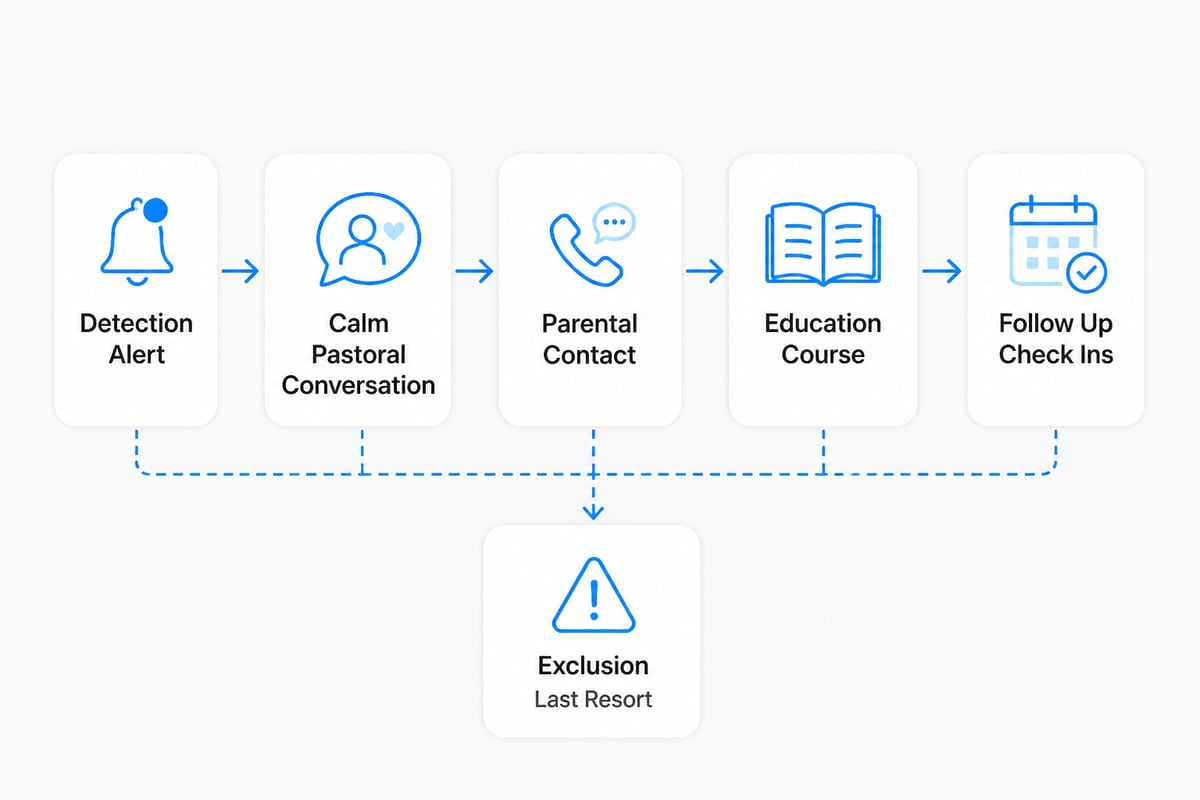
Schools support teenagers to quit most effectively when they combine education and rehabilitation with clear boundaries, rather than relying on exclusion alone. Removing a pupil from lessons for vaping can deepen the dependence and disconnect them from the people best placed to help.
A structured intervention gives staff something constructive to offer in place of a sanction. Vape Guardian Education is a 35 minute student vaping intervention course with six lessons and quizzes, designed with LifeLab at the University of Southampton. Used alongside pastoral conversations and parental contact, it gives a pupil the facts about nicotine and the skills to make a different choice, which supports rehabilitation as an alternative to exclusion.
Safeguarding leads can strengthen this approach by:
- Treating a first incident as a welfare concern as well as a behaviour matter.
- Offering the pupil an education course and a named member of staff for check ins.
- Informing parents promptly and sharing the same supportive message used in school.
- Reviewing patterns, such as repeated incidents in the same location, to identify who needs more help.
Why a vape free environment makes quitting easier
A teenager trying to quit is far more likely to succeed when vaping is hard to access and the environment does not constantly present temptation. Secluded areas such as toilets are where many pupils vape, and where a quitting teenager is most likely to be pulled back in by peers.
Detection technology supports this by making those spaces accountable without cameras. Vape Guardian sensors detect vaping, THC, Spice, cigarettes, over occupancy and loud noise, and alert staff in real time. Schools report vaping incidents halved within two weeks and almost eliminated by week five, and Seaham High School saw vaping in toilets fall by around 95% since alarms were installed. A quieter, safer environment protects pupils who want to quit, and gives staff the information to offer support early. For practical steps, see this guide on how to stop vaping in school toilets.
Detection and support belong together. Alerts tell staff where and when vaping is happening, and the pastoral response decides whether a pupil is helped or simply punished. Headteachers weighing policy options may also wish to read about UK school vaping laws and what headteachers need to know. Schools should rely on their own policies and clear signage while the law on vape free places is developed.
How to handle relapses and slips
A relapse is a normal part of quitting and should be treated as information, not failure. Many teenagers need several attempts before stopping completely, and a harsh reaction to a slip often ends the attempt altogether.
When a slip happens, adults can help by asking what triggered it, adjusting the plan and reaffirming that the goal is still achievable. Keep the focus on the next day rather than the setback. Praise effort and honesty, since a teenager who admits a slip is showing exactly the openness that makes recovery possible.
Parents and schools should also agree consistent expectations. If home is supportive but school responds only with sanctions, or the reverse, the mixed message undermines progress. A shared plan, with the same named adults and the same language, gives the teenager one clear path to follow.
FAQ
How to get a free vape?
Adults should not seek to obtain a free vape for a teenager, and vapes cannot legally be sold to anyone under 18 in the UK. Young people who want to stop should instead ask a GP, school nurse or pharmacist about quit support suited to their age.
How long does it take to stop craving nicotine?
Cravings are usually strongest in the first few days and tend to fade over several weeks, arriving in short waves rather than constantly. Teenagers often find them easier to manage with a plan for trigger situations and a trusted adult to check in with.
Should parents punish a teenager for vaping?
Punishment alone rarely works because it does not address nicotine dependence and can make a teenager hide their use. Clear boundaries combined with practical support, such as an education course and professional advice, are more likely to lead to lasting change.
Your next step is to arrange a calm, judgement free conversation with the pupil or family concerned, and agree one small action such as an education course or a GP appointment. For schools, Vape Guardian Education offers a ready made way to support pupils through that change, while detection in toilets and secluded areas reduces the opportunities that make quitting harder. To see how this could work on your site, Vape Guardian can provide a tailored recommendation, so get a quote or book a 15 minute call with the UK team.








Share:
Vape Detection and Education for Schools: A Practical Guide
Vaping Rehabilitation for Secondary School Pupils: A Guide